Views: 0 Author: Site Editor Publish Time: 2025-11-13 Origin: Site


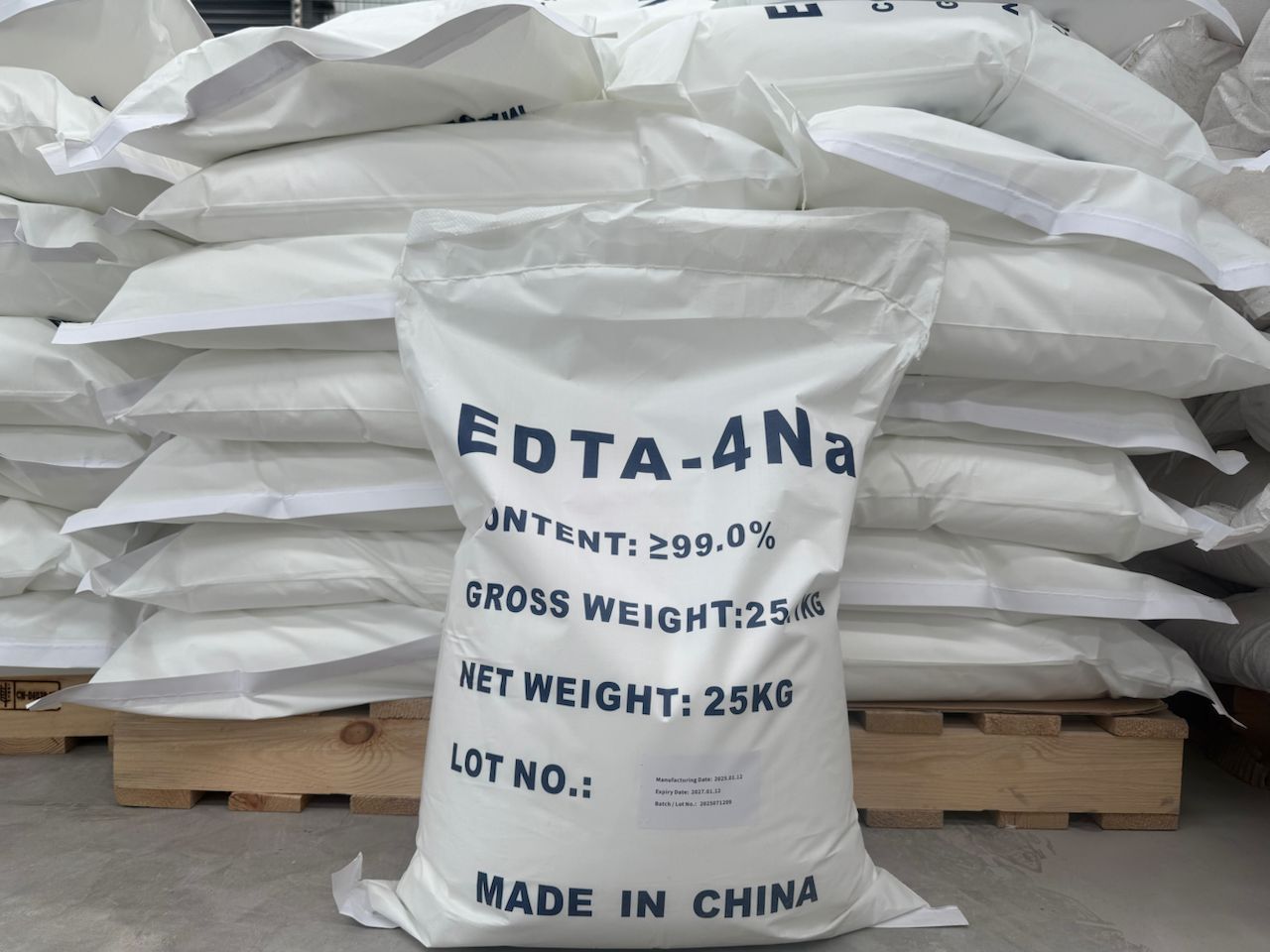
This article introduces the application of EDTA 4na in water treatment.
1. Boiler Water Treatment
This is the most important and classic application of EDTA-4Na.
Function: Prevents scale formation in boilers and heat exchange systems.
Descaling Principle: Boiler water typically contains scale-forming cations such as calcium (Ca⊃2;⁺) and magnesium (Mg⊃2;⁺). Traditional phosphate treatment generates calcium/magnesium phosphate sludge, requiring blowdown. EDTA-4Na,however, can directly combine with these ions to form extremely stable and highly soluble complexes (such as Ca-EDTA and Mg-EDTA). These complexes do not precipitate and can be discharged from the system with the wastewater, thus preventing scale formation n metal surfaces.
Advantages:Clean heat transfer surfaces: Keeps metal heat transfer surfaces absolutely clean, significantly improving thermal efficiency and reducing energy consumption.
Avoids sludge buildup: Does not produce precipitated sludge like in phosphate treatment, simplifying operation.
Suitable for high-parameter boilers: Especially suitable for large industrial boilers operating at high pressure and high temperature.
2. Industrial Cooling Water Systems
EDTA-4Na is also used to control scaling in both open and closed-loop circulating cooling water systems.
Function: Prevents scaling in equipment such as cooling towers and condenser pipes.
Principle: Similar to boiler water treatment, it prevents the formation of hard scale such as calcium carbonate and calcium sulfate by chelating calcium and magnesium ions.
3. As part of chemical cleaning agents
EDTA-4Na is a key ingredient in many chemical cleaning formulations used to remove existing deposits and rust from equipment.
Function: Dissolves and removes metal oxides and carbonate scale.
Principle:
For rust (Fe₂O₃, Fe₃O₄), EDTA, under appropriate pH and temperature, can dissolve iron oxide through chelation.
For calcium carbonate scale, it can directly chelate calcium ions, loosening and dissolving the scale layer.
This cleaning is usually carried out at high temperatures in the form of "EDTA ammonium salt," providing good cleaning results with low corrosiveness to the metal substrate.
4. As an Antioxidant Auxiliary Agent
In some water treatment formulations, EDTA-4Na is used as an auxiliary agent to enhance the effects of other agents.
It works by suspending catalytic metal ions (such as Cu2⁺, Fe2⁺/Fe3⁺) in the water to disrupt oxidation reactions.
Principle: These metal ions catalyze the oxidation of certain substances (such as ascorbic acid and sulfites) by dissolved oxygen, or directly accelerate the corrosion of metal equipment. EDTA-4Na "captures" these ions, causing them to deactivate, thus indirectly playing a role in antioxidation and corrosion inhibition.
Summary of Mechanism of Action The EDTA-4Na molecule acts like a six-pronged catcher; its six coordinating atoms (two nitrogen atoms and four oxygen atoms) can almost completely and tightly "grab" a metal ion, forming a highly stable, soluble, cyclic complex.
This structure is extremely stable, preventing the chelated metal ion from participating in precipitation formation or catalyzing other chemical reactions.
If any requirments,please contact us at info@hhaichem.com or 8613271577251.